Amos – Sabbath
Scripture References: Matthew 22:36-40, Amos 8:4-6, Exodus 5:4-5, Matthew 11:28-30.
Introduction:
Last week we were in the book of Amos, zooming in on Amos’ image of a plumb line. I encourage you to go back and read that devotional for full context, but let’s summarize what the situation is. Amos is prophesying against the northern kingdom of Israel. They have several sin problems going on. They are taking advantage of and oppressing the poor and needy. They are perverting justice and cheating others for economic gain. All while putting on this hypocritical front of worship, which God despised (See Amos 5:21-24). The bottom line is that Amos’ plumb line image showed that their lives did not line up with God’s standard of covenant obedience. They were missing the whole heart of the law, which Jesus himself sums up so perfectly:
36 “Teacher, which is the great commandment in the Law?” 37 And he said to him, “You shall love the Lord your God with all your heart and with all your soul and with all your mind. 38 This is the great and first commandment. 39 And a second is like it: You shall love your neighbor as yourself. 40 On these two commandments depend all the Law and the Prophets.” -Matthew 22:36-40 ESV
Love God – Love People. Israel is completely missing the mark at this point in their history. They have this attitude of, ‘I don’t care who suffers, as long as I am getting rich’. As I read through Amos, I stopped on a passage that both illustrated this mindset Israel found themselves in, but at the same time shows that we often carry a similar attitude today. At the heart of this passage is one key command that we so often neglect – The Sabbath. Listen to these words against Israel…
Devotional:
4 Hear this, you who trample on the needy
and bring the poor of the land to an end,
5 saying, “When will the new moon be over,
that we may sell grain?
And the Sabbath,
that we may offer wheat for sale,
that we may make the ephah small and the shekel[d] great
and deal deceitfully with false balances,
6 that we may buy the poor for silver
and the needy for a pair of sandals
and sell the chaff of the wheat?” -Amos 8:4-6 ESV
Translation: ‘When will the Sabbath be over so that we can make some more money and rip people off??’
This should make us stop dead in our tracks and think carefully. The implication is that they are ‘observing’ the Sabbath in the sense that they are not working…but they can’t wait for it to be over! It’s easy to tell that their hearts are not in it, at all. They are missing the whole heart of the Sabbath and the heart of the law itself.
If I’m honest, there are times I’ve found myself in a similar mindset and I’m sure many of us can relate. Why is it so hard for us to take 1 day a week of Sabbath rest? Why do we often find ourselves itching to get past it so we can ‘be productive’? Or perhaps we really don’t observe it at all…maybe we treat the Sabbath as just another day to get work done. This mindset just doesn’t line up with what we see in Scripture. There is a consistent emphasis on Sabbath and hard consequences pertaining to breaking Sabbath when we read through the law and prophets. For example – If we read through the 10 commandments in Exodus 20, we find that the Sabbath command is the lengthiest in terms of total words – 94 words if using ESV translation! In this sense, it is perhaps one of the most developed commandments among the 10.
Why so much emphasis on the Sabbath? For starters, it is important to understand the audience. Who was this Sabbath rest command given to in Exodus 20? The people of Israel…who JUST came out of slavery in Egypt.
These people were just in a situation where they’ve spent roughly 400 years as slaves in Egypt. We’re talking murder, oppression and tireless slave labor. Passages in Exodus even describe Pharaoh increasing their labor, but taking away tools and resources that they needed to do the work, which puts more strain and suffering on them (See Ex 5:5-26). Pharaoh’s words in Exodus 5 sum up their situation:
4 But the king of Egypt said to them, “Moses and Aaron, why do you take the people away from their work? Get back to your burdens.” 5 And Pharaoh said, “Behold, the people of the land are now many,[a] and you make them rest from their burdens!” – Exodus 5:4-5 ESV
You want them to rest?? Not a chance! For the people of Israel living at the time the Sabbath command is given – this is what they were born into and how they grew up. Their whole lives…They’ve been told that their worth – their value…is solely based on what they can produce.
The message to them is: ‘Your very survival is dependent on your work. Rest is weakness…Production is your identity!’
But what is God doing? He is now giving them a COMMAND to rest. One key truth God is teaching them (and us)…is that their worth is not tied to what they can produce. There is a time to work, of course…but that is not the chief end of man…that is not why God created them.
Maybe you need to hear this directly today: Your worth is not tied to what you can produce. Your worth is tied to who you are – a person made in the image of God…and whose you are – a child of God.
A God who needs nothing…we do not sustain God. He sustains us…He provides for us. He just asks us to trust Him. Pastor Chuck touched on this during last week’s sermon. Sabbath teaches us to trust in God, trust in His provision. This was the whole point of what God teaches the people shortly after they leave Egypt and are given manna, bread from heaven in Exodus 16. They are told to gather each day, but on the 6th day, gather twice as much so that they can truly rest on the 7th day. They don’t need to worry about their next meal, they need only to trust in God’s provision and rest in His care. Some follow this command, but some don’t trust in God’s provision and still try to gather on the 7th day…they can’t let go of the need to ‘take care of things themselves’…
As we see in Amos, Israel lost the plot of the story. Pastor Chuck brought up another key point when speaking about the Sabbath last week – Self-Reliance.
When we don’t trust God to provide, we fall into a mode of self-reliance. This is a dangerous place to be. Why?
We begin trusting ourselves more than God – and in that…we effectively take God off the throne, and put ourselves on the throne. We focus on our own accomplishments, our own success – and we may get to the point where we say – I’m good on my own….I don’t need God. This is where Israel eventually found themselves.
What’s even worse, Israel demonstrates further effects that self-reliance can have. It leads to oppression and abuse of others. Israel had become the very thing God delivered them from…they had become Egypt.
Here’s the slippery slope…
If my security, provision and needs depend solely on my production…Then everyone else becomes either competition or a tool.
People are no longer precious – made in the image of God to us…they just become expendable.
Without the regular reminder of Sabbath rest…life becomes more work, more wealth, more success, more more more…and it’s never enough.
In the end, we destroy ourselves and we destroy others…we turn our backs on the one who gave us life. Without Sabbath, we are still in bondage. We are still in slavery in Egypt. Sabbath rest frees us from this, in that we are able to trust God and rest in Him, knowing that we don’t need to worry about figuring it out on our own. We still work diligently, when it is time to work…but Sabbath rest must be a regular reminder of the One in whom we place our faith and trust.
I recently read a book titled ‘The Message of Jeremiah’ written by professor and theologian, Christopher J.H. Wright. He writes this about the message of the Sabbath…
“The Sabbath, moreover is a living reminder that life is more than economics, that the sum total of existence is greater than the accumulation of things, unbridled consumption, and feverish accomplishment. Work can cease and life will go on…The Sabbath says ‘yes’ to the sacred, to compassion, to human dignity, and to economic propriety. At the same time it says ‘no’ to self or national aggrandizement, the insidious need for more, exploitation, and frenzy for upward mobility. As such, it cultivates a just and fair society.”1
I pray that this brief study helps us start to think more clearly about Sabbath and why the Bible stresses its importance so often…perhaps much more than we stress its importance today. This was one of the first lessons God taught Israel after delivering them from bondage in Egypt – how to REST.
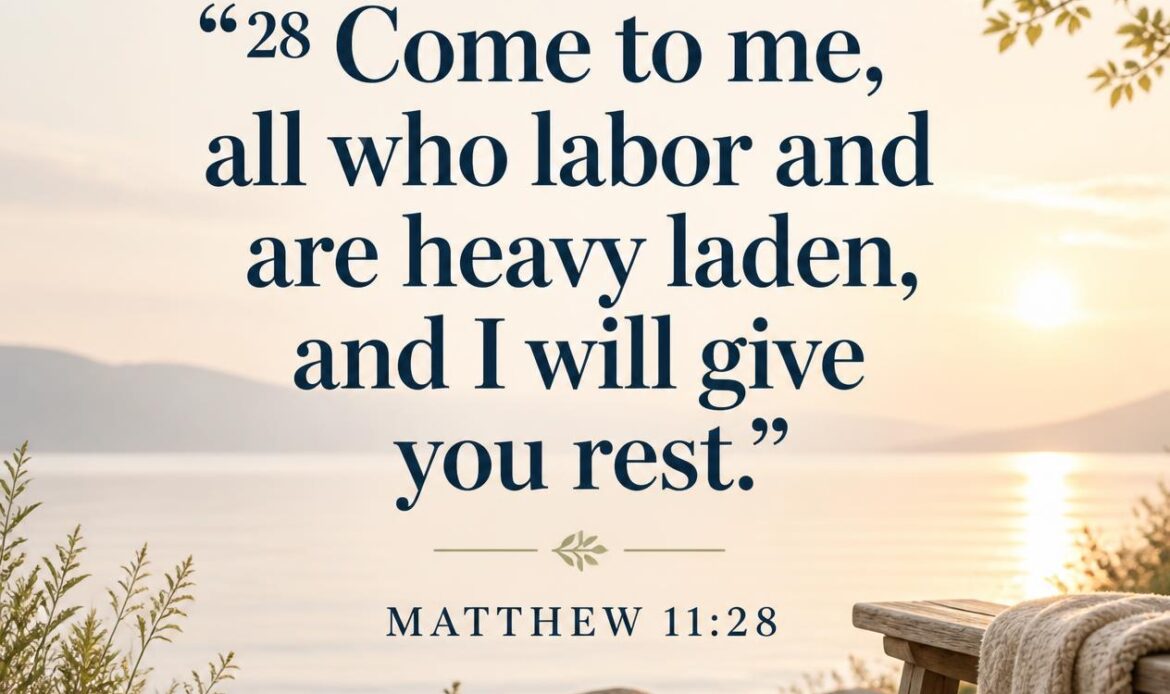
This is the same invitation Jesus extends to us, and I pray we all accept this invitation…
28 Come to me, all who labor and are heavy laden, and I will give you rest. 29 Take my yoke upon you, and learn from me, for I am gentle and lowly in heart, and you will find rest for your souls. 30 For my yoke is easy, and my burden is light.” -Matthew 11:28-30 ESV
Amen.
Sean Wagner
- Christopher J.H. Wright, The Message of Jeremiah, The Bible Speaks Today (Downers Grove, IL: IVP Academic, 2014), 202. ↩︎