Amos’s Plumb Line
Scripture References: Amos 5:21-24, 3:1-2, 7:2b-3, 5b-6, 7:7-9, Exodus 12:13, 2 Corinthians 5:21
Introduction:
Have you ever approached a project with a sense of overconfidence? Picture this – you’re doing a DIY project in your home. You’ve done a few of these before and in the past, you approached the situation carefully. You planned things out, made sure you had the right tools and laid out the right process to follow. In those past experiences, there were perhaps some challenges as you learned, but ultimately the end product was a success.
Now, you have a new project. You’ve gained some knowledge and experience, your confidence goes up and maybe you’re not as calculated as you were before…maybe this time you think: “You know what, I don’t think I need the leveling tool this time to hang that shelf…I’m confident that I can just eyeball it”…perhaps some of us can relate to this.
Well, this time things don’t turn out so well. Your attempt to use your own perception and neglect that leveling tool results in a crooked shelf. Now you need to take it down, patch the old holes you carelessly drilled and hang the shelf the right way, using the proper tools and standards (Can you tell I’m speaking from past experience?).
The topic of worship has been on my mind a lot the past couple weeks. As I write this, we are about to have an evening of worship at the church, singing praises together as a community. We’ve touched on worship in recent devotionals and Pastor Chuck discussed this in his sermon a couple weeks ago. We talked about worship being about approaching God on His terms, not ours. We also were challenged with this: Do our lives reflect an attitude of worship throughout the week? What do our lives look like when we leave our church building on Sunday?
You might ask, what does this illustration of a DIY project have to do with worship? Good question! The answer lies in a similar illustration found in the book of Amos…
Devotional:
To set the stage, the prophet Amos is speaking to the northern kingdom of Israel before the Assyrian conquest of the land. The prophet is sent to speak on God’s behalf…to call out Israel’s sin and call on them to repent. The consequence if they choose not to listen: Destruction. Amos is very specific in the type of sin he is calling out as it is repeated throughout the book:
- Exploiting the poor and needy (Amos 2:6-7, 4:1, 8:4-6)
- Corrupting justice (Amos 5:7, 10-12)
- Accepting bribes (Amos 5:12)
- Dishonest economic practices (Amos 8:5)
- Religious hypocrisy (Amos 5:21-24)
These are just a few examples. The passage in the last bullet point above gets to the heart of Israel’s problem. They had the appearance of being religious, but their worship was corrupt in that their lives reflected a much different reality. They abused people for their own gain…but put on a great ‘show’ in their religious practices…
21 “I hate, I despise your feasts,
and I take no delight in your solemn assemblies.
22 Even though you offer me your burnt offerings and grain offerings,
I will not accept them;
and the peace offerings of your fattened animals,
I will not look upon them.
23 Take away from me the noise of your songs;
to the melody of your harps I will not listen.
24 But let justice roll down like waters,
and righteousness like an ever-flowing stream. – Amos 5:21-24 ESV
God had enough of it. Israel, much like the Scribes and Pharisees Jesus spoke harshly against in the gospel accounts, have become religious hypocrites (See Matthew 23). Throughout Amos, we also see that Israel had developed this sense of overconfidence and a false sense of security, just because they were ‘Israel’…God’s chosen people. Nearly the whole chapter of Amos 6 speaks to this attitude. We also read this in Amos 3:
Hear this word that the Lord has spoken against you, O people of Israel, against the whole family that I brought up out of the land of Egypt:
2 “You only have I known
of all the families of the earth;
therefore I will punish you
for all your iniquities. -Amos 3:1-2 ESV
What is the message from God here and how does it speak to Israel’s overconfidence and false sense of security? Israel being God’s chosen people, were in covenant with God. This comes with a certain responsibility to be a kingdom of priests and reflect the character of God to the nations. However, In the mind of Israel at this point in their history, the way they lived said: “We are God’s chosen people” – “Therefore we are safe from any consequences”…
God is saying, you got this all wrong! “You are my chosen people” – “Therefore I will hold you accountable!”
When we get to chapter 7…The consequences of Israel’s sin are becoming imminent. God shows Amos a series of images depicting judgement and destruction:
- Judgement by a locust plague:
“O Lord God, please forgive!
How can Jacob stand?
He is so small!”
3 The Lord relented concerning this:
“It shall not be,” said the Lord. -Amos 7:2b-3 ESV
Amos intercedes – God relents
2. Judgement by fire:
“O Lord God, please cease!
How can Jacob stand?
He is so small!”
6 The Lord relented concerning this:
“This also shall not be,” said the Lord God. -Amos 7:5b-6 ESV
Amos intercedes again – God relents
Now comes a different image…
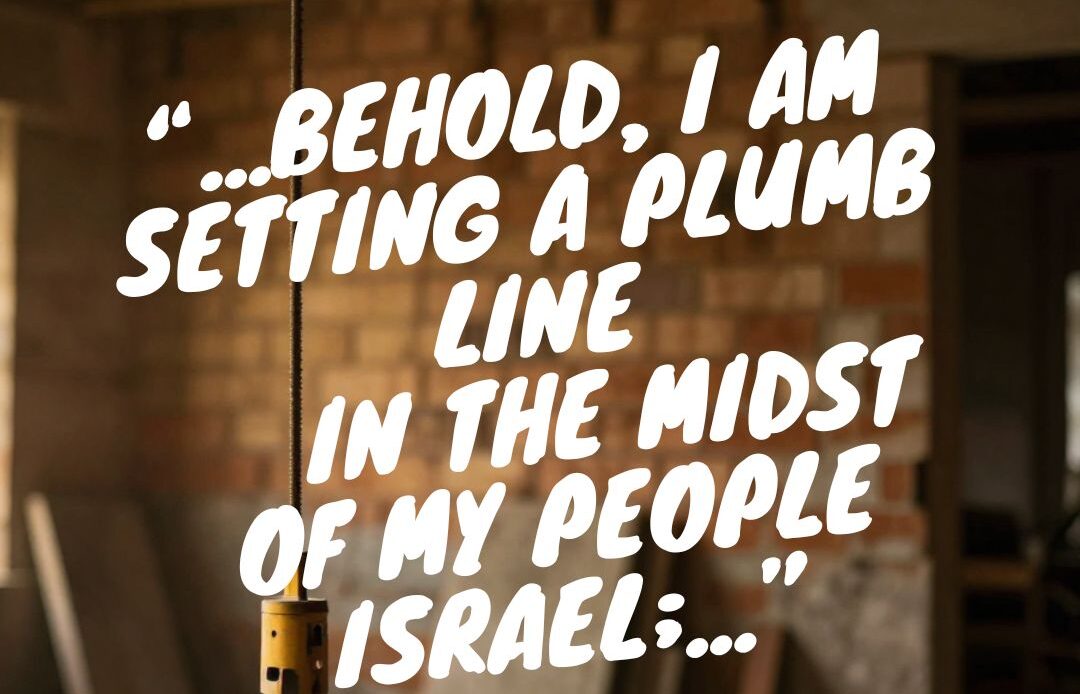
7 This is what he showed me: behold, the Lord was standing beside a wall built with a plumb line, with a plumb line in his hand. 8 And the Lord said to me, “Amos, what do you see?” And I said, “A plumb line.” Then the Lord said,
“Behold, I am setting a plumb line
in the midst of my people Israel;
I will never again pass by them;
9 the high places of Isaac shall be made desolate,
and the sanctuaries of Israel shall be laid waste,
and I will rise against the house of Jeroboam with the sword.” -Amos 7:7-9 ESV
Remember our DIY illustration from the introduction? Here’s where it really comes into play. God presents the image of a plumb line. In case you’re not familiar, a plumb line is a simple construction tool. It is a cord with a heavy weight attached to it. When suspended, gravity causes the weight to hang perfectly vertical. Builders used it to determine whether a wall was straight and truly vertical. If a wall had been built crooked, the plumb line would expose this error.
Can you start to see where God is going with this image? He is setting a plum line ‘in the midst of my people Israel’. The result…God says ‘I will never again pass by them’…some translations, such as the NIV translate this as: ‘I will spare them no longer’. We then see God pointing to the coming destruction by sword, alluding to the coming Assyrian conquest. Notice that Amos does not intercede this time. God has made his judgement clear. This time He will not relent…he will no longer spare Israel. They’ve been given chances, they’ve been given prophets to warn them of this, and they had not repented and turned back to God. The message of the plumb line is this:
I have measured my people against my standard, and they are no longer in alignment.
The plumb line represents God’s objective standard of covenant righteousness. The hard reality was that Israel’s worship and their lives did not line up to that standard. This is precisely what the image of the plumb line exposes.
Being ‘Israel’ did not mean immunity from God’s standard, it meant being held accountable to it.
Much like our DIY project – in our overconfidence, we may not think we need the right tools and standards to complete the project. We think we can make our own standard – Be our own standard. The result is a carelessly executed project that has to be torn down and redone the right way. So how does this get fixed? Is there any hope in this story?
The ESV translation of the last line of Amos 7:7 – ‘I will never again pass by them’ alludes to an interesting reversal in Israel’s story. Amos on several occasions throughout the book had called Israel back to remember their story. They were once slaves in Egypt and God delivered them from bondage. As part of that deliverance, God executes judgement on Egypt. He passes through the land and strikes down all the firstborn (Exodus 12). But Israel is commanded to mark their houses with the blood of a lamb…
13 The blood shall be a sign for you, on the houses where you are. And when I see the blood, I will pass over you, and no plague will befall you to destroy you, when I strike the land of Egypt. -Exodus 12:13 ESV
In Exodus 12, we see judgement upon Egypt. God passes over Israel, sparing them. Not because they were righteous in and of themselves, but simply because they obeyed God’s voice by applying the blood – and it was the blood of the lamb that covered them.
In Amos 7, we see judgement being visited upon Israel…except this time God says ‘I will no longer pass by them’. They’ve broken their covenant with God. They will not be spared.
Where our humble DIY illustration falls short…and what Amos’s plumb line image exposes, is that I can never meet God’s standard. I can’t just tear it down and rebuild it myself. Israel is the case study for this. Because in my own hands…that wall is eventually going to get crooked again. God knows this…that’s why He sent Jesus.
21 For our sake he made him to be sin who knew no sin, so that in him we might become the righteousness of God. -2 Corinthians 5:21 ESV
Since the only one who can measure up to God’s standard is God himself, His son Jesus – If we are in Christ, we are clothed in His righteousness. A new creation, part of a new covenant in His blood. The blood of the Lamb.
May we examine ourselves this week. Does our worship of God extend beyond our songs, studies, sermons and gatherings and shape the way we live? Is our worship reflected in the way we treat others, pursue righteousness and obey God?
Worship is not merely what happens in a worship service – it is a life of obedience flowing from a heart devoted to God.
“The Lamb of God in my place
Your blood poured out, my sin erased
It was my death You died, I am raised to life
Hallelujah, the lamb of God” – Lamb of God
Amen.
Sean Wagner