Gratitude When The Wheels Come Off
Let’s say, for the sake of illustration, that one Sunday after church I’m talking with two people who tell me they are football fans and really started getting into football around 2000. As we’re talking, I find out that one is a Patriots fan and the other is a Lions fan, even though both grew up locally to our church.
Any idea which of the two people’s fandom I’ll think is more authentic?
It’s 100% the Lions fan. And not because we share an affinity for the same team. Anyone who can endure what a Lions fan endured from 2000–2020 is a legit fan.
Allow me to illustrate briefly with a few stats between the two teams. We’ll just look at the “Tom Brady era” with the Patriots (2001–2019) [19 seasons]
Patriots Lions Winning Percentage 76% 34% Superbowls wins 6 (31%) 0 Super bowl Appearances 9 (47%) 0 Conference Championship Appearances 13 (68%) 0 Best Season Record 16-0 9-7 Worst Record 9-7 0-16
Here is the Too Long Didn’t Read summary for those of you who don’t care about football stats: The Patriots were historically good during that time, and the Lions were historically bad.
Why the statistical report? Because whether you like sports or not, knowing what the Lions endured gives us a greater appreciation for the fans who continued to support the team.
There is something about proclaiming our adoration for something in the bad times as well as the good times that resonates with people as genuine adoration.
Few things demonstrate an authentic faith to those around us more clearly than our ability to continue praising God when life gets difficult.
There is something real about a faith that can still say, “Thank You, God. I worship You, my hope and trust is in You” when the wheels have come off in our lives.
Our key passage for this Sunday is Habakkuk 3:17–19:
Though the fig tree should not blossom,
nor fruit be on the vines,
the produce of the olive fail
and the fields yield no food,
the flock be cut off from the fold
and there be no herd in the stalls,
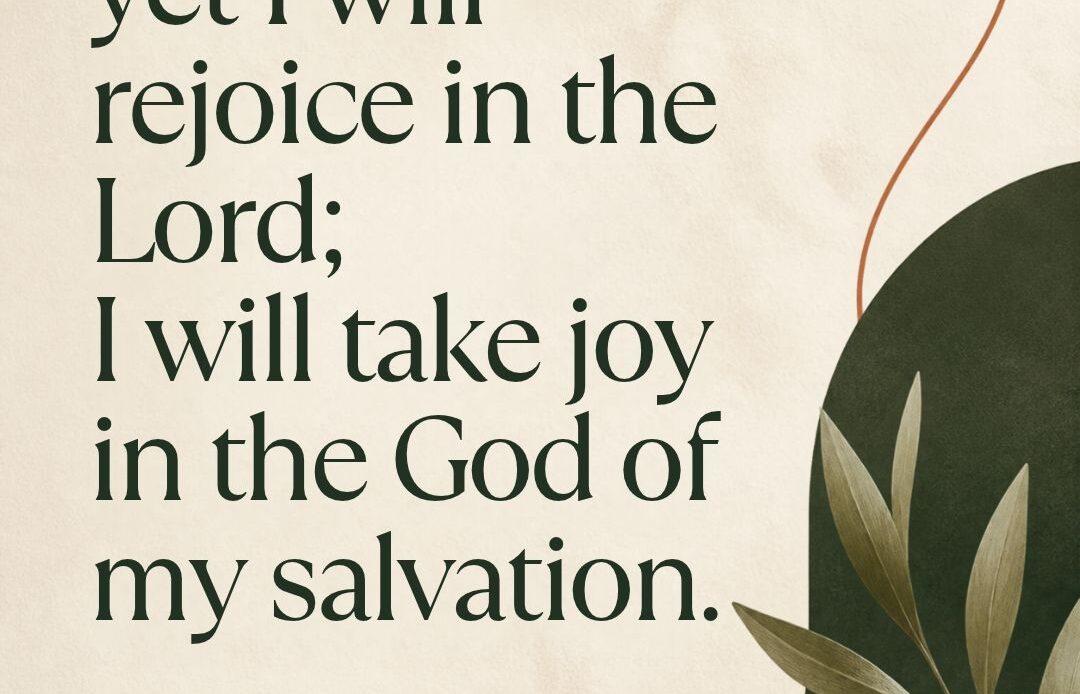
yet I will rejoice in the Lord;
I will take joy in the God of my salvation.
God, the Lord, is my strength;
he makes my feet like the deer’s;
he makes me tread on my high places.
David Guzik says this about the words of Habakkuk: “In almost a vision, Habakkuk saw the Judean countryside desolate, perhaps from the invading Babylonian army or perhaps from natural calamity. In the midst of this almost complete loss, Habakkuk could still rejoice in the LORD.”1
Joy can often be substituted as a synonym for rejoice.
The One Minute Bible for Students by Doug Fields describes Joy as follows “True joy isn’t dependent on anything, joy is an attitude that lives within you. Someone who possesses joy doesn’t change when the situation changes.”2
We see a real life example of this play out in Acts 16 with Paul and Silas
Paul and Silas were thrown in jail (Acts 16:16–24) and Acts 16:25–34 tells a story of great impact in spite of less-than-ideal circumstances.
25 About midnight Paul and Silas were praying and singing hymns to God, and the prisoners were listening to them, 26 and suddenly there was a great earthquake, so that the foundations of the prison were shaken. And immediately all the doors were opened, and everyone’s bonds were unfastened. 27 When the jailer woke and saw that the prison doors were open, he drew his sword and was about to kill himself, supposing that the prisoners had escaped. 28 But Paul cried with a loud voice, “Do not harm yourself, for we are all here.” 29 And the jailer[a] called for lights and rushed in, and trembling with fear he fell down before Paul and Silas. 30 Then he brought them out and said, “Sirs, what must I do to be saved?” 31 And they said, “Believe in the Lord Jesus, and you will be saved, you and your household.” 32 And they spoke the word of the Lord to him and to all who were in his house. 33 And he took them the same hour of the night and washed their wounds; and he was baptized at once, he and all his family. 34 Then he brought them up into his house and set food before them. And he rejoiced along with his entire household that he had believed in God.
Notice how the passage starts. Paul and Silas were in jail, and they were singing. Somehow, in the midst of being imprisoned for their faith, they were able to have joy.
The testimony that we display in our actions in the small things is just as important as our actions in the big things. Our actions and attitudes in the little things, especially in hard times, help make our actions in the big things more trustworthy.
I believe that the fact that they are singing songs to God helped their witness in the eyes of the jailer who would later put his trust in Christ.
If we are able to praise God in the middle of the storms in our lives, when we then give a reason for the hope that is in us (1 Peter 3:15), that reason is going to carry much more weight with the people around us because they know it’s not just a statement; it’s something that impacts and transforms every area of our lives.
I don’t think any of us have to look far to find something we wish would be different in our lives or in our world. Does the “reason for the hope that is in you” (1 Peter 3:15) come through in those situations as much as it does when things are going well?
Spend some time in prayer and reflection this week asking God to help you to rejoice in Him in an area that is less than Ideal. Ask Him to remind you of his faithfulness and goodness and to help you see beyond the desolation in front of you.
Adam
- David Guzik, “Habakkuk 3 – Study Guide,” Blue Letter Bible, https://www.blueletterbible.org/comm/guzik_david/study-guide/habakkuk/habakkuk-3.cfm. ↩︎
- Doug Fields, One-Minute Bible for Students (Nashville: Holman, 2007), 78. ↩︎