God’s Pursuing Grace
This week’s sermon focuses on the story of Adam and Eve in Genesis 2:18–3:20—the moment when sin enters the world through their disobedience.
Each week, as part of his sermon, Pastor Chuck shares a “big idea” for his sermon, this week’s is especially fitting for a week where we learn about sin and celebrate communion.
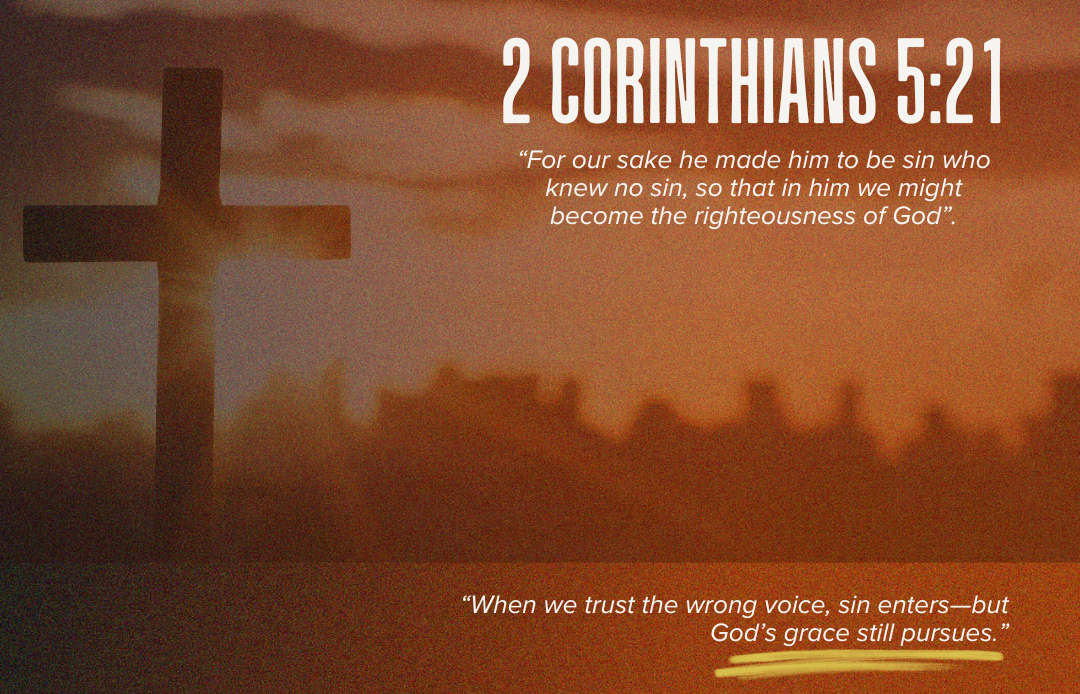
The big idea: “When we trust the wrong voice, sin enters—but God’s grace still pursues.”
In our key text Eve was deceived by the serpent, and Adam followed right along. In Genesis 2:15–17, God gives the command not to eat from the tree of the knowledge of good and evil:
“15 The Lord God took the man and put him in the garden of Eden to work it and keep it. 16 And the Lord God commanded the man, saying, ‘You may surely eat of every tree of the garden, 17 but of the tree of the knowledge of good and evil you shall not eat, for in the day that you eat of it you shall surely die.’”
The command isn’t the main focus of today’s devotional; it’s the conversation between Eve and the serpent in Genesis 3:1-4
“He said to the woman, ‘Did God actually say, “You shall not eat of any tree in the garden”?’ And the woman said to the serpent, ‘We may eat of the fruit of the trees in the garden, but God said, “You shall not eat of the fruit of the tree that is in the midst of the garden, neither shall you touch it, lest you die.”’”
When I read these verses, I cannot help but think about how this interaction is the same one we all face on a daily basis.
Many of us know what the Word of God says, and even if you’re new to the faith, odds are there is a part of you that knows you shouldn’t do certain things. But knowing doesn’t always make it easier to do what honors God. There is almost always another “voice” trying to convince us that doing what we want is better than doing what God wants.
Until the day we are united with Christ in eternity, we will always have to fight the temptation—to choose what pleases us and instead choose what honors God.
That is why I love Pastor Chuck’s big idea for this week so much. Because we will fail—it’s not a matter of if, but when. However, even in our failure, God’s grace pursues.
Our closing song, “How Deep the Father’s Love for Us,” illustrates this truth very well.
The first verse is a lyrical illustration of 2 Corinthians 5:21:
“For our sake he made him to be sin who knew no sin, so that in him we might become the righteousness of God.”
“How deep the Father’s love for us
How vast beyond all measure
That He should give His only Son
To make a wretch His treasure
How great the pain of searing loss
The Father turns His face away
As wounds which mar the Chosen One
Bring many sons to glory”
Christ on the cross took our sin upon Himself so that we might become the righteousness of God—or, as the song puts it, “to make a wretch His treasure.”
To paraphrase Tim Keller “on the cross Jesus suffered a punishment we deserved so that God would treat us as Christ deserves”
Verse two tells us that it was our sin that held Christ to the cross—not in a literal sense though.
Jesus says in John 10:18, “No one takes it from me, but I lay it down of my own accord. I have authority to lay it down, and I have authority to take it up again. This charge I have received from my Father.”
It was out of love that Jesus chose to stay on the cross so that our sins could be forgiven.
Behold the Man upon a cross
My sin upon His shoulders
Ashamed I hear my mocking voice
Call out among the scoffers
It was my sin that held Him there
Until it was accomplished
His dying breath has brought me life
I know that it is finished
The final verse reminds us that God’s grace is not a result of our own works, but instead a free gift from God.
Ephesians 2:8–9 says, “For by grace you have been saved through faith. And this is not your own doing; it is the gift of God, not a result of works, so that no one may boast.
I will not boast in anything
No gifts no pow’r no wisdom
But I will boast in Jesus Christ
His death and resurrection
Why should I gain from His reward
I cannot give an answer
But this I know with all my heart
His wounds have paid my ransom
“Why should I gain from His reward? … But this I know with all my heart: His wounds have paid my ransom.”
We have brought nothing to this relationship and the fact is we have failed to live up to God’s standard and we will continue to fail over and over again for the rest of our lives. Yet, the great news is that God’s love for us doesn’t depend on our performance.
In spite of our failures and shortcomings God continues to pursue us with His Grace.
Romans 5:8 says, “But God shows His love for us in that while we were still sinners, Christ died for us.”
Lamentations 3:22-23 “The steadfast love of the Lord never ceases; his mercies never come to an end; they are new every morning; great is your faithfulness.”
Thank God for His pursuing grace.
Adam