You’ve Never Failed And You Won’t Start now
This summer our staff is working through a series of discussions on the topic of trust—the different ways we, as leaders, can either earn or lose the trust of the people in our church. What’s interesting is that, when you study trust, you realize everyone “trusts” differently.
You have those who give trust freely until it’s no longer warranted.
You have those who withhold trust—sometimes for too long
Not only that, but there are different levels of trust. You can have full trust or partial trust in someone. What’s even more interesting is that the level of trust you have in someone can vary depending on the task.
For example, we are currently running a soccer camp at our church. My soccer experience consists of two seasons about 30 years ago! If you were interested in signing your child up for our soccer camp and I were the head coach, you probably wouldn’t trust that your child would receive quality soccer instruction from someone with my coaching experience.
On the other hand, people within our church leadership trust me to organize the program. (Step One: Find a good coach!)
The Bible tells us over and over again to trust God. When it does, it doesn’t imply varying levels of trust. Rather, it calls us to complete dependence upon Him.
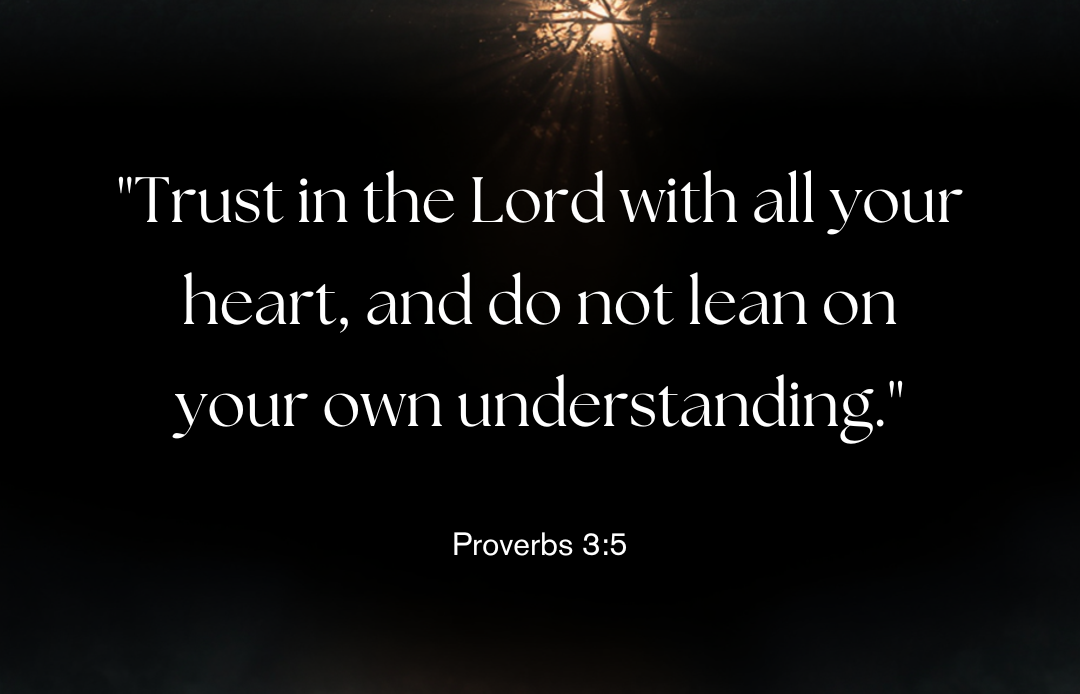
Proverbs 3:5: “Trust in the Lord with all your heart, and do not lean on your own understanding.”
The New Bible Commentary says, “Trust and lean both suggest the physical experience of supporting yourself on something or someone in total and helpless reliance and commitment.”1
In other words, the Bible calls us to full dependence upon God. I’ve heard pastors illustrate it by describing someone leaning against a wall, putting their full weight on the wall trusting it will not collapse. God desires that kind of trust from us in every situation.
This Sunday, during prelude, we are going to sing a song that, when you hear it, you can’t help but think of Peter walking on the water (Matthew 14:22–33). The song speaks to our utter dependence upon God in unknown and trying situations.
“And I will call upon Your name
And keep my eyes above the waves
When oceans rise
My soul will rest in Your embrace
For I am Yours and You are mine”
I want to draw your attention specifically to the line, “And keep my eyes above the waves.”
In the Matthew account of Peter walking on the water, verse 30 says, “But when he saw the wind, he was afraid, and beginning to sink he cried out, ‘Lord, save me!'”
Peter began to sink when he took his eyes off Jesus.
Warren Wiersbe says this about Peter:
“What caused Peter to sink? His faith began to waver because he took his eyes off the Lord and began to look at the circumstances around him. ‘Why did you doubt?’ Jesus asked him (Matt. 14:31). This word translated doubt carries the meaning of ‘standing uncertainly at two ways.’ Peter started out with great faith but ended up with little faith because he saw two ways instead of one.”2
Notice the difference between the definitions of the words trust and lean in Proverbs 3 and doubt in Matthew 14.
Trust & Lean: “Total and helpless reliance and commitment.”
Doubt: “Standing uncertainly at two ways.”
You can’t have total commitment and uncertainty at the same time. They are mutually exclusive.
Yet that is exactly where we often find ourselves, at times, in our relationship with God. I can tell you that in my own life there are certain areas where I have complete trust in God, and others where I find myself divided between two ways—between trusting my own knowledge and abilities and trusting God’s.
Warren Wiersbe offers an interesting perspective on why Jesus walked to the disciples on the water:
“Why did Jesus walk on the water? To show His disciples that the very thing they feared (the sea) was only a staircase for Him to come to them.”3
God’s authority over the things that worry us and fill us with fear is often the thing that He uses to help us learn to trust in His faithfulness.
Verse 2 of our prelude song ‘Oceans’ contains the lines
“Where feet may fail and fear surrounds me
You’ve never failed and You won’t start now”
The next time you find yourself in a situation where your trust in God is divided, may you lean on Warren Wiersbe’s reminder that “the sea was only a staircase for Him to come to them” and the words of this song point you back to the truth that God has dominion over all things (Psalm 103:19) and that He has never failed—not once—and never will (Hebrews 10:23).
Adam
- Goldingay, John E. 1994. “Proverbs.” In New Bible Commentary: 21st Century Edition, edited by D. A. Carson, R. T. France, J. A. Motyer, and G. J. Wenham, 4th ed., 589. Leicester, England; Downers Grove, IL: Inter-Varsity Press. ↩︎
- Wiersbe, Warren W. 1996. The Bible Exposition Commentary. Vol. 1. Wheaton, IL: Victor Books. ↩︎
- Wiersbe, Warren W. 1996. The Bible Exposition Commentary. Vol. 1. Wheaton, IL: Victor Books. ↩︎