Give Thanks In All Circumstances
This week we are starting a three-week series on thankfulness. Our key text for the series is
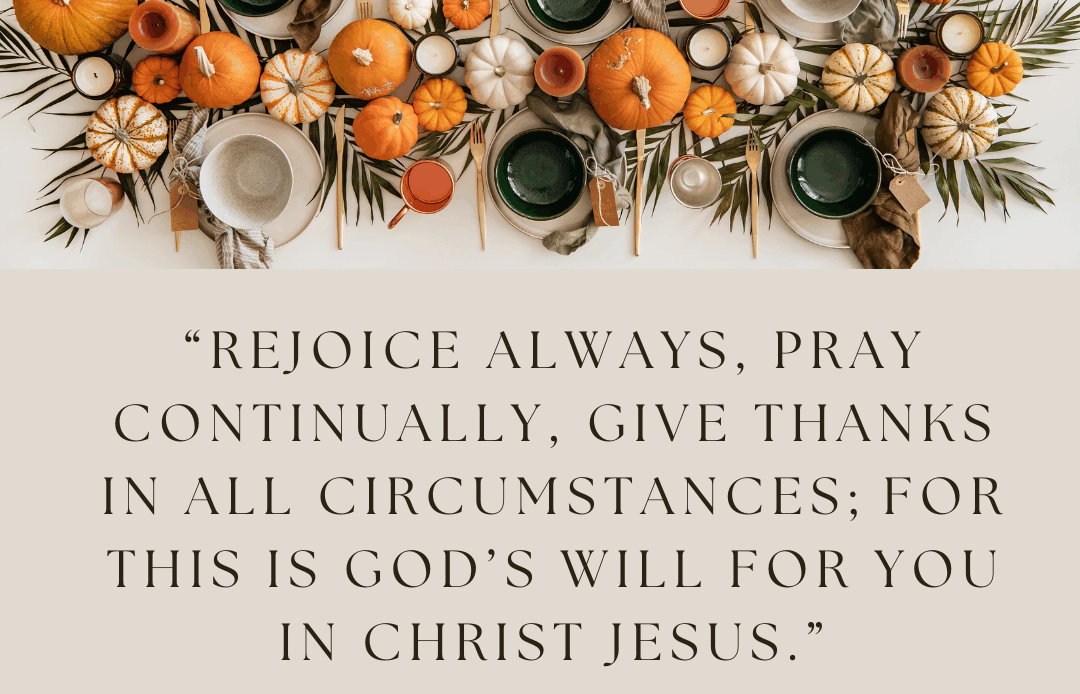
1 Thessalonians 5:18: “Give thanks in all circumstances; for this is God’s will for you in Christ Jesus.”
If we zoom out a little, we’ll see that our theme verse is part of a larger section that focuses on instructions to believers. Paul gives a list of things followers of Christ should be doing. If you zoom in a little further, you’ll find that verse 18 is actually the last part of a sentence that gives us three things we should be doing constantly:
1 Thessalonians 5:16–18: “16 Rejoice always, 17 pray continually, 18 give thanks in all circumstances; for this is God’s will for you in Christ Jesus.”
The way this sentence is written implies that these aren’t just “good things to shoot for.” They are more like commands for believers. Believers should rejoice always, pray continually, and give thanks in all circumstances.
If you’re anything like me (which is a scary thought), your first reaction after reading those verses might be: How is that possible!?
I think the reason it sounds impossible is because our emotions are so deeply tied to our actions.
One of the things it took me a long time to realize is that I’m an emotional eater.
If things are good, let’s celebrate with some good food. If things are bad, let’s cope by eating something delicious.
Here’s where the reality of the strength of our emotions comes in: I am now well aware of the fact that I’m an emotional eater. However, that awareness hasn’t led to changed behavior. My emotions still seem to run the show in this area of my life.
The command to rejoice, pray, and give thanks continually and in all circumstances seems impossible because when we face difficult times, it’s the opposite of what we want to do—and when life is good, it’s often an afterthought.
Look at Luke 17:11–19. This is the story of Jesus healing the ten lepers. Out of the ten He healed, only one came back and thanked Him—only one returned in true thanksgiving.
Charles Spurgeon said this: “But the internal matter, the drawing out of the heart in thankful love—how scarce a thing it is!”1
Nine of the ten went on with their lives after having received what they desired.
Think about your life: how often have you fervently prayed for something only to move on with little to no acknowledgment of God’s provision?
How many times have you found yourself in a difficult moment—day, week, or even longer—and it consumes your mood to the point where praise and thankfulness seem impossible?
These, whether we like it or not, are our natural responses.
But to quote the New Bible Commentary:
“Paul adds, because God intends it to be so; he wants his people to be joyful, prayerful and thankful, and he makes it possible for them to be so.”2
God doesn’t want us to rejoice, pray, and be thankful for His benefit—He doesn’t need anything from us. But it is for His glory and our good. And He makes it possible for us to do so.
God is in the business of making the impossible possible. By earthly standards, it is nearly impossible to rejoice and be thankful in difficult situations. By heavenly standards, it’s not only possible—it’s expected.
So what makes it possible to make the switch? It’s remembering the mercy, grace, and love that God has shown us.
This Sunday, our songs are focused around the understanding that we have endless reasons to rejoice and to give thanks.
Here’s a brief overview of some of the lyrics we’ll sing:
“Streams of mercy, never ceasing, call for songs of loudest praise.”
“Let Thy goodness, like a fetter, bind my wandering heart to Thee.”
“Lord, I’m amazed by You… how You love me.”
“For all Your goodness I will keep on singing—ten thousand reasons for my heart to find.”
As we think about thankfulness this time of year, I’ll close with a Tim Keller quote:
“It’s one thing to be grateful. It’s another to give thanks. Gratitude is what you feel. Thanksgiving is what you do.” — Tim Keller
May we take time during this season of thankfulness to pause, resist reacting based on our feelings, and remember the countless reasons we have to thank God for who He is and what He has done in our lives.
Adam
- https://www.blueletterbible.org/comm/guzik_david/study-guide/luke/luke-17.cfm?a=990011 ↩︎
- Marshall, I. Howard. 1994. “1 Thessalonians.” In New Bible Commentary: 21st Century Edition, edited by D. A. Carson, R. T. France, J. A. Motyer, and G. J. Wenham, 4th ed., 1284. Leicester, England; Downers Grove, IL: Inter-Varsity Press. ↩︎