Zephaniah – I AM
Scripture References: Colossians 1:16-17, Zephaniah 2:13-15, Isaiah 45:5-6, Genesis 1:26, Daniel 4:27, 30-32, 34
Introduction:
As we continue our preaching series on prayer this fall, I am reminded of important truths. A life dedicated to prayer is a life which consistently acknowledges that I am a creation, completely dependent on a Creator. When we come to the Lord with a proper mindset of prayer, we are humbly acknowledging that we are submitting to God’s authority. We did not create ourselves, we cannot sustain ourselves. The fact that we woke up today is a testament to the mercy and grace of God – the creator and sustainer of all things…
16 For by him all things were created, in heaven and on earth, visible and invisible, whether thrones or dominions or rulers or authorities—all things were created through him and for him. 17 And he is before all things, and in him all things hold together. -Colossians 1:16-17 ESV
This is a truth that I was reminded of during my study of the prophets, particularly the prophet Zephaniah…
Devotional:
Zephaniah, like other books we sometimes label as ‘minor’ prophets, are anything but minor. The truth of God’s Word comes through just as powerfully as any book of the Bible.
While the messages of the prophets are often targeted at Israel, God’s covenant people…we also see that the nations surrounding Israel are not left out of the picture. Several prophets have lengthy sections dedicated to words against surrounding nations, such as: Isaiah Ch. 13-34, Jeremiah Ch. 46-51, Ezekiel Ch. 25-32 and Amos 1-2 to name a few. We also see books of the Bible dedicated to words against other nations, such as: Obadiah (The nation of Edom) and Nahum (The nation of Assyria). So while harsh words are certainly directed towards Israel and their covenant unfaithfulness, this does not mean God has turned a blind eye to the conduct of other nations. Both Israel and the nations are in view from both a judgement and a redemption standpoint (more on the redemptive side of things in next weeks devotional!)
In Zephaniah 2, we see a word against Judah’s enemies (Philistia, Moab, Ammon, Cush and Assyria). The nation of Assyria (who the book of Nahum is targeted towards) is the nation who conquered the northern kingdom of Israel in 722 BC. Zephaniah has this to say to the nation of Assyria…
13 And he will stretch out his hand against the north
and destroy Assyria,
and he will make Nineveh a desolation,
a dry waste like the desert.
14 Herds shall lie down in her midst,
all kinds of beasts;
even the owl and the hedgehog
shall lodge in her capitals;
a voice shall hoot in the window;
devastation will be on the threshold;
for her cedar work will be laid bare. -Zephaniah 2:13-14 ESV
We may remember that Nineveh (Assyria’s capital) was the main focus of the book of Jonah. In Jonah, we see God’s command to speak against the city in order that they may repent and receive God’s mercy. Though Jonah wishes to see the city destroyed, God reminds Jonah that He cares for that city…even if Jonah thinks they deserve destruction without the opportunity to repent. Nahum and Zephaniah show us the other side of that coin. We are reminded that God is merciful, but he is also just and will deal with evil. Zephaniah’s words will eventually come to fruition when Assyria, the most powerful nation in that time period is destroyed by a new empire, Babylon. So what brought on these harsh words of destruction towards Assyria? Zephaniah gets down to the heart of the issue In the following verses…
15
This is the exultant city
that lived securely,
that said in her heart,
“I am, and there is no one else.”
What a desolation she has become,
a lair for wild beasts!
Everyone who passes by her
hisses and shakes his fist. -Zephaniah 2:15 ESV
“I am, and there is no one else”. There lies the central problem.
That specific phrase is striking because “I am… and there is no one else” is essentially the language of divine uniqueness associated with God. Look at how it is used in Isaiah when God commissions Cyrus of Persia…
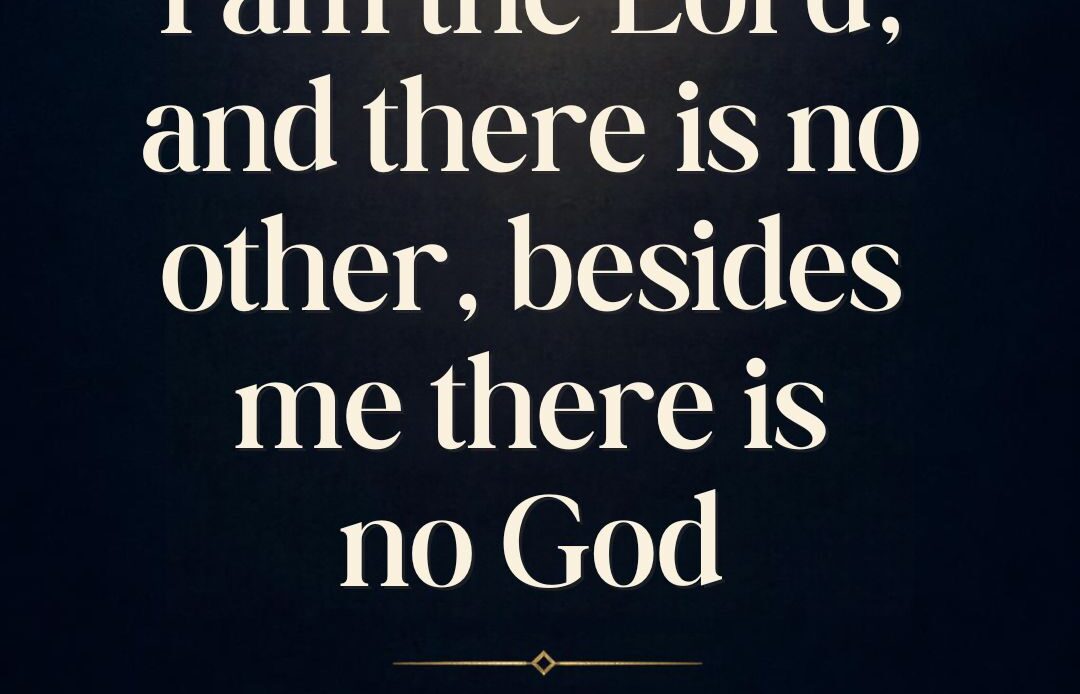
5 I am the Lord, and there is no other,
besides me there is no God;
I equip you, though you do not know me,
6 that people may know, from the rising of the sun
and from the west, that there is none besides me;
I am the Lord, and there is no other. -Isaiah 45:5-6 ESV
And in the very next chapter…
8 “Remember this and stand firm,
recall it to mind, you transgressors,
9 remember the former things of old;
for I am God, and there is no other;
I am God, and there is none like me, –Isaiah 46:8-9 ESV
When Assyria says in their heart: “I am, and there is no one else”…essentially, they are declaring: ‘I am all there is. I am the focus. I am the object of my own worship…I am above the God who created me.’
As the theologian, Carl Friedrich Keil wrote in his Zephaniah commentary:
“But how has this self-deifying pride been put to shame!”1
The creature has appropriated the Creator’s claim to uniqueness and worship. So how does God respond? He reverses creation order on them…
In Genesis 1:26–28, humanity is created in God’s image and given dominion over the animal world:
26 Then God said, “Let us make man in our image, after our likeness. And let them have dominion over the fish of the sea and over the birds of the heavens and over the livestock and over all the earth and over every creeping thing that creeps on the earth.” -Genesis 1:26 ESV
Humanity holds a distinct position in the created order: under God, but above the animals, exercising delegated dominion.
Now look at the language in Zephaniah 2:14..
“Herds shall lie down in her midst,
all kinds of beasts;
even the owl and the hedgehog
shall lodge in her capitals;
a voice shall hoot in the window;
devastation will be on the threshold;
for her cedar work will be laid bare”
The great city that thought itself invincible, above its Creator, is now a habitat for animals. Their dominion is taken away. This motif of a creation-order reversal is common in the prophets. A couple other examples can be found in Jeremiah 50 and Isaiah 13, where Babylon is punished just as Assyria was punished.
O. Palmer Robertson in his Zephaniah commentary (New International Commentary on the Old Testament) says this:
“The ultimate irony of Zephaniah’s prophecy is the return of the beast over man. In the garden, man was given dominion over the creaturely world. In the day of judgment upon Nineveh, the beasts take up residence in the architecture of man. The birds sing in the windows and the desert creatures lodge in the pillars. Human pride is flattened, and creation is thrown out of its proper orbit.”2
But perhaps the most intimate example is seen in Daniel 4 where King Nebuchadnezzar is told after Daniel interprets his dream:
27 Therefore, O king, let my counsel be acceptable to you: break off your sins by practicing righteousness, and your iniquities by showing mercy to the oppressed, that there may perhaps be a lengthening of your prosperity.” -Daniel 4:27 ESV
But Nebuchadnezzar’s response is:
30 and the king answered and said, “Is not this great Babylon, which I have built by my mighty power as a royal residence and for the glory of my majesty?” 31 While the words were still in the king’s mouth, there fell a voice from heaven, “O King Nebuchadnezzar, to you it is spoken: The kingdom has departed from you, 32 and you shall be driven from among men, and your dwelling shall be with the beasts of the field. And you shall be made to eat grass like an ox, and seven periods of time shall pass over you, until you know that the Most High rules the kingdom of men and gives it to whom he will.” -Daniel 4:30-32 ESV
Nebuchadnezzar elevates himself above the Most High, admiring his own creation. So God essentially takes away His dominion and demotes him to the dominion of beasts. When he comes to His senses, he learns an important truth…
34 At the end of the days I, Nebuchadnezzar, lifted my eyes to heaven, and my reason returned to me, and I blessed the Most High, and praised and honored him who lives forever, for his dominion is an everlasting dominion, and his kingdom endures from generation to generation; -Daniel 4:34 ESV
Nebuchadnezzar learns that God’s dominion is everlasting. Any dominion given to a human king or kingdom can be taken away as God sees fit. When we put ourselves in place of our Creator, we get things completely backwards. We worship the creation rather than the Creator.
This is what Nebuchadnezzar learned by experience and this is the punishment we see placed on Assyria in Zephaniah 2.
Takeaway:
Back to our thoughts laid out in the introduction. When we live a life dedicated to prayer…we begin approaching God with a proper realization of our place and an admission of our reliance on Him.
We reject an attitude of: ‘I am, and there is no one else’.
We assume an attitude of: ‘You are LORD, and there is no other’
When this is our approach in prayer, we acknowledge that God is God, and we are not. That He is the creator and sustainer of all things. Apart from Him, we can do nothing. We are fully reliant on Him.
As we sing the lyrics to this song on Sunday, may it be our prayer:
Lord I come, I confess
Bowing here, I find my rest
Without You, I fall apart
You’re the one that guides my heart
Lord, I need You… – Lord I need You
16 For by him all things were created, in heaven and on earth, visible and invisible, whether thrones or dominions or rulers or authorities—all things were created through him and for him. 17 And he is before all things, and in him all things hold together. -Colossians 1:16-17 ESV
Amen.
Sean Wagner