What about my performance?
Scripture References: John 14:15, Romans 4:1-3, Genesis 12:2, Genesis 15:1, 5-11, 17, Ephesians 2:8
Introduction:
We live in a performance-driven culture. We feel that constant pressure to perform on a daily basis. Whether that is at work, school, family responsibilities, community activities…you name it. This may lead us to ask questions regarding our relationship with God. What does God expect of me? What is that balance of faith and performance (or faith and works)? Is there even a balance? We addressed some of these questions in last week’s devotional, so if you haven’t checked it out yet, I encourage you to go back and read it!
The book of James, as we’ve been seeing in our sermon series ‘reset’, addresses these questions brilliantly by showing our performance (or works) as an outpouring of our saving faith. Put another way, our performance does not save us, it is faith alone. Why then worry about works? Because our works make our faith evident. People see the way we act, the way we serve and it puts our saving faith on display and becomes a means to share the gospel with others. It also demonstrates obedience to the very God to whom we proclaim that faith. It shows that we have a genuine love for our savior. Jesus puts it simply:
“If you love me, you will keep my commandments.” -John 14:15 ESV
Last week, we also highlighted God’s unchanging nature by showing examples where God’s commands in the Old Testament are consistent with New Testament teaching. Today, we are going to zoom in on a moment in the life of Abraham which is attested to in the New Testament. The topic of focus is – what we can learn about Abram’s ‘performance’? Let’s dive in…
Devotional:
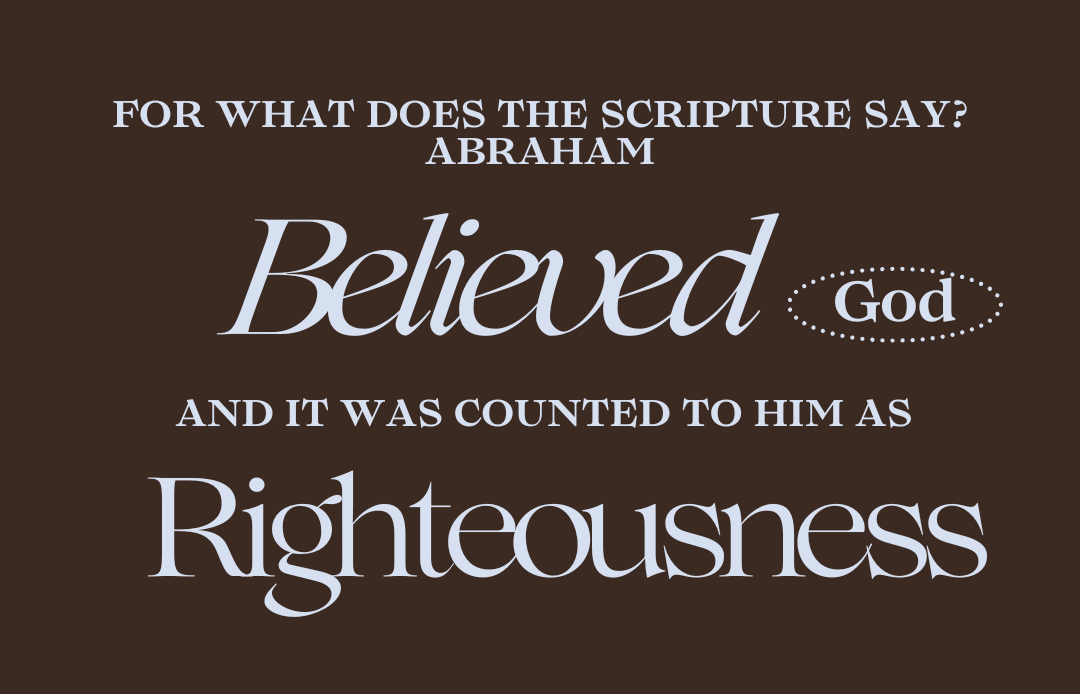
“What then shall we say was gained by Abraham, our forefather according to the flesh? 2 For if Abraham was justified by works, he has something to boast about, but not before God. 3 For what does the Scripture say? “Abraham believed God, and it was counted to him as righteousness.” -Romans 4:1-3 ESV
Paul in Romans is picking up on a key Old Testament passage in the life of Abraham which is key to our understanding of performance and works. Paul’s quote “Abraham believed God, and it was counted to him as righteousness” comes from Genesis 15 right before a peculiar covenant ceremony. Genesis 15 begins like this…
“After these things the word of the Lord came to Abram in a vision: “Fear not, Abram, I am your shield; your reward shall be very great.” -Genesis 15:1 ESV
‘After these things…’ After what things? Any time we see a chapter or passage open like this, our immediate response should be to go back and see what came before. In this case it provides crucial context for what is about to happen. If we were to take a step back to Genesis 14, we see an episode where Abram goes on a rescue mission to save his nephew Lot in the face of overwhelming odds. Despite his small band of men compared to the overwhelming numbers of an army, Abram successfully rescues Lot, his possessions, the women and other people who were captured.
Not only does he perform this rescue in the face of impossible odds, risking his own life…but he does this following the promise he received from God – “2 And I will make of you a great nation, and I will bless you and make your name great, so that you will be a blessing. (Gen 12:2 ESV). Abram also declines a reward offered to him by the king of Sodom for this brave rescue mission.
This is the context for our opening verse in Gen 15:1. ‘Fear not, Abram, I am your shield’ (verse 1a) – Abram being severely outnumbered did not seek to preserve his own life, but he acted selflessly. What was the source of his protection? – it was the Lord – ‘I am your shield’. His 2nd selfless act was not accepting the reward offered to him by man. God addresses this act of selflessness as well – ‘your reward shall be very great’. Abram still has his questions given that his wife Sarai is barren – but God reiterates His promise to Abram:
“And he brought him outside and said, “Look toward heaven, and number the stars, if you are able to number them.” Then he said to him, “So shall your offspring be.” 6 And he believed the Lord, and he counted it to him as righteousness.” -Genesis 15:5-6 ESV
What does this tell us about Abram’s performance? Though Abram’s actions in Genesis 14 were selfless, the verse doesn’t read as ‘After he did all these selfless works, he counted it to him as righteousness’ – no. He ‘believed the Lord, and he counted it to him as righteousness.’ It was faith in God’s promise and God’s protection. This is evidence that our performance or works are a product of faith.
The covenant ceremony that follows is another striking demonstration that God’s promise and Abram’s righteousness is not dependent on Abram’s performance. Let’s look at that piece now…
And he said to him, “I am the Lord who brought you out from Ur of the Chaldeans to give you this land to possess.” 8 But he said, “O Lord God, how am I to know that I shall possess it?” 9 He said to him, “Bring me a heifer three years old, a female goat three years old, a ram three years old, a turtledove, and a young pigeon.” 10 And he brought him all these, cut them in half, and laid each half over against the other. But he did not cut the birds in half. 11 And when birds of prey came down on the carcasses, Abram drove them away. -Genesis 15:7-11 ESV
Being thousands of years removed from this time and culture, this may seem strange to us…but what God is telling Abram to do was actually a common practice in Ancient Near Eastern culture. Ancient Near East scholars refer to this practice as ‘cutting a covenant’. The Faithlife study Bible commentary states:
“The animals are cut in half, and the halves separated. The most common expression for making a covenant in the OT uses the Hebrew word karath (meaning “to cut”). This is because covenants usually involved literally cutting animals. This type of covenant practice was common in the ancient near east.”
“Ordinarily, those entering into a covenant would walk through the halved carcasses-indicating that they should end up like the animals if they break the agreement (see Jer 34:17-20). The fate of the sacrificial animals is applied onto the participants.”1
What is God doing here? He is addressing Abram’s questions and concerns in a way that Abram would understand. But there is an interesting part of this covenant ceremony that is different from what would normally have taken place in this culture. As stated above, usually both parties (in this case it would be Abram and God), would walk between both halves. The message being: “May what happened to these animals happen to me if I break this covenant”. But that is not what happens. Here’s what actually happens…Abram falls into a deep sleep, God gives him a prophetic message and we read this:
“When the sun had gone down and it was dark, behold, a smoking fire pot and a flaming torch passed between these pieces.” -Genesis 15:17 ESV
Two ‘participants’ did in fact walk through these pieces…but Abram was not one of them! Faithlife Study Bible comments:
“In this case, only Yahweh – whose presence is signaled by the fire pot and flaming torch- passes through.”
Again, what does this tell us about Abram’s performance? Although Abram displayed good works and had acted selflessly, we also know that there are instances in his life where he shows lack of trust and acts out of self-preservation – he makes mistakes like we all do. By God passing through these pieces himself…it means this particular covenant and promise is not dependent on Abram’s performance – whether he does well, or whether he screws up. This is accomplished by the work of the Lord…Abram’s role – to believe it!
What is the takeaway?
This study of Abram makes a connection between our Old Testament and our New Testament…
“What then shall we say was gained by Abraham, our forefather according to the flesh? 2 For if Abraham was justified by works, he has something to boast about, but not before God. 3 For what does the Scripture say? “Abraham believed God, and it was counted to him as righteousness.” -Romans 4:1-3 ESV
“For by grace you have been saved through faith. And this is not your own doing; it is the gift of God, 9 not a result of works, so that no one may boast.” -Ephesians 2:8 ESV
It was grace in the Old Testament and it is grace in the New Testament.
How does this impact how we live today? God accomplished the work necessary for salvation. We no longer need to carry the weight of our sin. Therefore, we are called to simply embrace that truth and believe it. We then show our love for Him and others by obeying His Word. Our good works are an outpouring of love which can help point others to saving faith.
I close with a line from one of our worship songs this week that I think fits perfectly…
“No more I boast in what I can bring
No more I carry the weight of sin
For He has brought me from death to life
I stand in the Gospel of Jesus Christ” – There is one Gospel, by CityAlight
Amen.
Sean Wagner
- Genesis 15:10 – Barry, John D., Douglas Mangum, Derek R. Brown, Michael S. Heiser, Miles Custis, Elliot Ritzema, Matthew M. Whitehead, Michael R. Grigoni, and David Nomar. 2012, 2016. Faithlife Study Bible. Bellingham, WA: Lexham Press. ↩︎