For His glory and my good
Scripture References: Daniel 1:6, 3:15-17, 4:37, Mark 14:34-35, 2 Corinthians 4:17-18,
Introduction:
“There is hope in every trial
For I can trust the Lord
He will turn my heart towards Him
And help me bear the thorn
So in faith I follow Jesus
On the road not understood
For I know that He is working
For His glory and my good’
– ‘His glory and my good’ by: CityAlight
These song lyrics caught my attention this week. There is an important theological point being made here. When we say things like: ‘God is working things out for our good.’ How exactly do we define ‘good’? What does that look like?
I’m sure we can all relate to these lyrics in one way or another…because it speaks to our faith in God’s sovereign plan despite suffering, despite confusing or unknown circumstances: ‘There is hope in every trial’…’help me bear the thorn’…’On the road not understood’.
The reality is, we trust God, we trust His plan…but does that mean everything turns out ‘good’? Well, again it depends on how we define ‘good’. Does it mean that we will always get what we want? Will things go according to our preferences? Our desires? I think if we’ve lived long enough on this earth we can confidently say that things don’t always go according our plans. We simply don’t get what we ‘want’ or what we ‘desire’ in many circumstances. So what do we mean when we say something like the song lyric above?: “For I know that He is working for His glory and my good”…
Before we come to any kind of definition or conclusion, It’s important to see this illustrated in Scripture. There is a particular passage that came to my mind this week and it may sound familiar…
Devotional:
In Daniel chapter 1 we are introduced to some Hebrew youths.
6 Among these were Daniel, Hananiah, Mishael, and Azariah of the tribe of Judah. – Daniel 1:6 ESV
One of those names sounds familiar right off the bat (Daniel), but we likely would better recognize the other 3 by their Babylonian names – Shadrach, Meshach and Abednego.
After Jerusalem fell to Babylon, the people of Judah were carried into captivity. These youths were perceived as the ‘best and brightest’ by their Babylonian captors. Faithlife study Bible (FSB) comments:
“Babylonians often detained and educated royal captives. These captives could later be returned to their homeland as influential sympathizers to their overlords…”
“Indoctrination was the key to successfully integrating captives into their new homeland. In addition to learning the history of their overlords, captives would also learn their language and religious practices. The incorporation of political, cultural, and religious education made captives look favorably upon those who conquered them. They could then be used by their overlords to spread Babylonian ideologies and propaganda.”1
In short, the best and brightest of these young Hebrew men go through a sort of state-sanctioned ‘brainwashing’. To cap this off, their names are changed. Their Hebrew names are taken away and they are given Babylonian names. This is a detail we should not overlook, because in their culture, this was meant to essentially change their very identity and allegiances. FSB also comments:
“Hananiah, Mishael and Azariah – These Hebrew names identify the three young men with the God of Israel: Hananiah (“Yahweh has acted graciously”); Mishael (may mean “Who is what God is”); and Azariah (“Yahweh has helped”)…”2
The commentary continues with this example:
“For Daniel and Azariah, the Hebrew references to God in their names (-el for God or -iah for Yahweh) are replaced with references to Babylonian deities like Nabu or Marduk (Also called Bel). Their new names symbolized serving Babylon.”3
The Babylonians are basically saying, ‘You no longer serve the God of Israel, you serve Babylon and its gods.’
This hardly seems like an ideal, preferable, or ‘good’ situation to be in. It’s these moments where we may ask in distress…‘God, what are you doing?’
Despite the attempts of their captors to change their identity and their allegiances, we get a stunning look at the faithfulness of these young men. The scene I want to focus on comes in Daniel chapter 3 when Nebuchadnezzar commands they fall down and worship his golden image. Nebuchadnezzar tells them in fury…
“But if you do not worship, you shall immediately be cast into a burning fiery furnace. And who is the god who will deliver you out of my hands?” – Daniel 3:15b ESV
This is the moment of truth. After their indoctrination…who are they going serve?
16 Shadrach, Meshach, and Abednego answered and said to the king, “O Nebuchadnezzar, we have no need to answer you in this matter. 17 If this be so, our God whom we serve is able to deliver us from the burning fiery furnace, and he will deliver us out of your hand, O king.[d] 18 But if not, be it known to you, O king, that we will not serve your gods or worship the golden image that you have set up.” -Daniel 3:16-17 ESV
This response is stunning for several reasons. First and foremost, their allegiances haven’t been swayed despite Babylon’s best attempts to brainwash them. They hold to their faith in the God of Israel.
But what is fascinating and what particularly relates to our topic today is the fact that they acknowledge God ‘can’ deliver them (‘our God whom we serve is able to deliver us…), but they accept that this may not be part of God’s plan. God ‘may not’ deliver them and they submit themselves fully to the will of God (“But if not, be it known to you, O king, that we will not serve your gods or worship the golden image that you have set up.”)
As the rest of the story goes, God does deliver them! I don’t know about you, but facing the possibility of death in a fiery furnace is far from anything I would ‘want’ and would most certainly not align with my ‘preferences’. So, if that is my definition of ‘good’, then I’m missing the point. I’m holding a very near-sighted view of what I think is ‘good’ if I think God is just going to work things out to accommodate my personal comfort.
The hope in this passage not only is shown through God’s deliverance, but in the after effects. After Nebuchadnezzar witnesses this event and a subsequent humbling experience in Chapter 4…we hear him say these words:
37 Now I, Nebuchadnezzar, praise and extol and honor the King of heaven, for all his works are right and his ways are just; and those who walk in pride he is able to humble. -Daniel 4:37 ESV
These words are part of a decree Nebuchadnezzar shares with all of Babylon. Through the trials, suffering and pain of God’s faithful servants, the Name of the Lord and His glory is proclaimed throughout the greatest empire of that time, by the king himself!
God’s good purposes for us often reach beyond our immediate circumstances.
One final illustration comes in the garden of Gethsemane…right before Jesus is arrested to face a gruesome, painful and humiliating death…
34 And he said to them, “My soul is very sorrowful, even to death. Remain here and watch.”[d] 35 And going a little farther, he fell on the ground and prayed that, if it were possible, the hour might pass from him. 36 And he said, “Abba, Father, all things are possible for you. Remove this cup from me. Yet not what I will, but what you will.” -Mark 14:34-35 ESV
Do we hear the similarity in this statement from Jesus to that of Shadrach, Meshach and Abednego? Like the Hebrew youths, Jesus knows that the Father ‘can’ deliver Him (“all things are possible for you. Remove this cup from me.”), but He accepts that the Father ‘may not’ do this (“Yet not what I will, but what you will.”) Jesus submits to the will of the Father, despite the immediate circumstances.
As we know, unlike Shadrach, Meshach and Abenego who were delivered from a gruesome death…It was the will of God that Jesus would experience His gruesome death (see Isa 53:10, Acts 2:23)…but the ‘good’ that comes from His suffering has eternal significance. The apostle Paul understands this quite well…
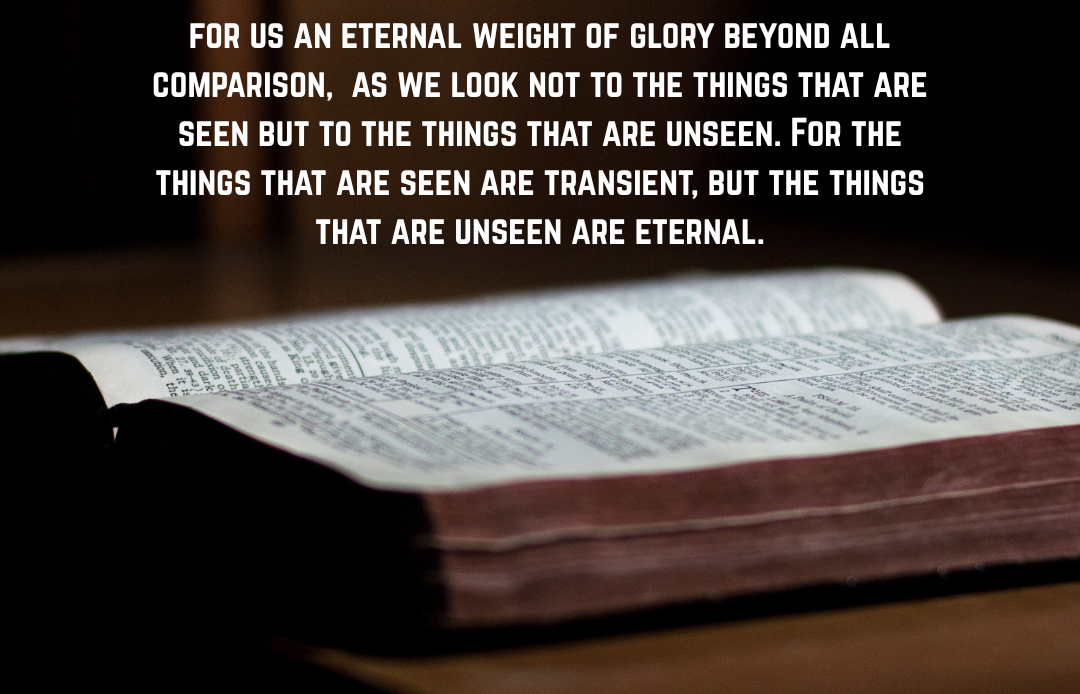
17 For this light momentary affliction is preparing for us an eternal weight of glory beyond all comparison, 18 as we look not to the things that are seen but to the things that are unseen. For the things that are seen are transient, but the things that are unseen are eternal. -2 Corinthians 4:17-18 ESV
Our affliction, our suffering our immediate discomfort is, as Paul says: ‘transient’ (greek: ‘proskairos’)…meaning ’for a season’, ‘enduring only for a while’, ‘temporary’4
What is not temporary? A ‘weight of glory beyond all comparison’, ‘things that are unseen’…These things are not temporary. As Paul shows us…these things are ‘eternal’.
Takeaway
-Re-examining the song lyrics from our introduction: “For I know that He is working for His glory and my good.” What we’ve seen through our illustrations, is that our ‘good’ goes beyond our temporary circumstances and points to something eternal. (See Rom 8:18)
-Our circumstances may not always look ‘good’ to us…they may even feel terrible…but as Scripture teaches us, it is nothing compared to the joy, the glory and the rest we will experience when we place our Faith in Jesus. Our pain is temporary, but His glory and our ‘good’ is eternal.
God, help us not be so near-sighted, but instead look to how Your plan is unfolding…resulting in eternal glory and good beyond anything we can possibly imagine.
Amen.
Sean Wagner